Lesson 3
Where is a restroom?
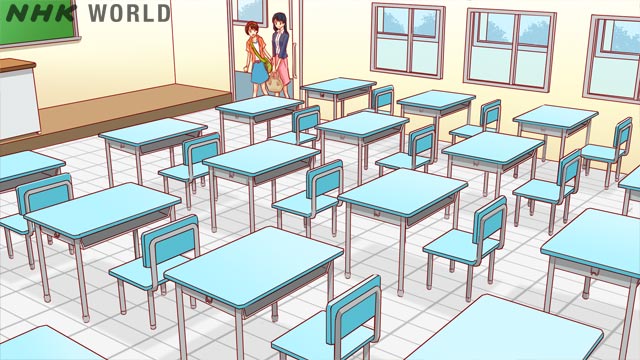
Today, Sakura takes Anna around the university.

Key phrase:
TOIRE WA DOKO DESU KA
Scripts
| さくら | ここは教室です。 | Here's a classroom.
|
|---|---|---|
| Sakura | KOKO WA KYÔSHITSU DESU.
Here's a classroom.
|
|
| アンナ | わあ、広い。 | Oh, it's spacious.
|
| Anna | WÂ, HIROI.
Oh, it's spacious.
|
|
| さくら | あそこは図書館。 | Over there is the library.
|
| Sakura | ASOKO WA TOSHOKAN.
Over there is the library.
|
|
| アンナ | トイレはどこですか。 | Where is a restroom?
|
| Anna | TOIRE WA DOKO DESU KA.
Where is a restroom?
|
|
| さくら | すぐそこです。 | Just over there.
|
| Sakura | SUGU SOKO DESU.
Just over there.
|
Grammar tips
WA DOKO DESU KA
 (Where is ___ ?)
DOKO DESU KA is a phrase that allows you to ask where something is, either a place or thing.
e.g.) TOIRE WA DOKO DESU KA. (Where is a restroom?)
Teach Us, Teacher
Demonstratives
Demonstratives are the words we use, when we point to the things, persons or places we are talking about. We call them KO-SO-A-DO words, taking the first syllables of the demonstratives of four groups.
Sound Words
Animals walking
Japanese is a language with lots of onomatopoeia. A wide range of onomatopoeia in the Japanese language, from noises made by animals to expressions of feelings, is explained by audio.
Anna's Tweets
When I asked, "TOIRE WA DOKO DESU KA," people taught me where. I was understood in Japanese. Now I can find my way anywhere.