Lesson 10
Is everyone here?
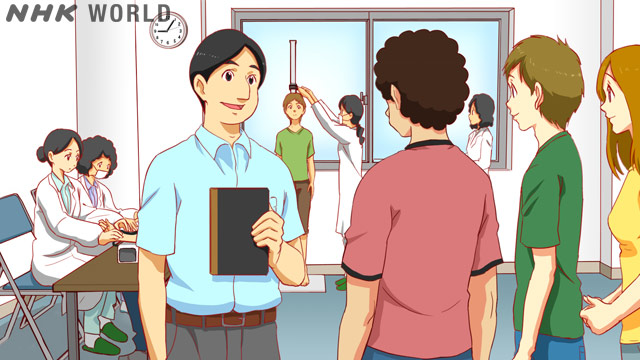
Today, Anna has a health examination at her university. Students have been gathering at the examination site.

Key phrase:
ZEN-IN IMASU KA
Scripts
| 先生 | はじめに身長と体重をはかります。 全員いますか。 |
At first, we measure your height and weight. Is everyone here?
|
|---|---|---|
| Teacher | HAJIMENI SHINCHÔ TO TAIJÛ O HAKARIMASU. ZEN-IN IMASU KA. At first, we measure your height and weight. Is everyone here?
|
|
| ロドリゴ | アンナさんがいません。 | Anna is not here.
|
| Rodrigo | ANNA-SAN GA IMASEN.
Anna is not here.
|
|
| アンナ | すみません。遅れました。 | I'm sorry. I'm late.
|
| Anna | SUMIMASEN. OKUREMASHITA.
I'm sorry. I'm late.
|
Grammar tips
MASHITA: Past form of MASU
 To turn MASU-form verbs to the past form, you change MASU to MASHITA.
e.g.) TABEMASU (to eat)
>> TABEMASHITA (ate)
Teach Us, Teacher
IMASU and ARIMASU
In Lesson 7, Anna was surprised at seeing many cakes at the store, and said KÊKI GA IPPAI ARIMASU (There are lots of cakes). As in this case, if the subject is an inanimate thing, we use ARIMASU. We decide whether a thing is animate or inanimate, not only on whether it is alive, but also on whether it can move of its own will.
Sound Words
Disappointment
Japanese is a language with lots of onomatopoeia. A wide range of onomatopoeia in the Japanese language, from noises made by animals to expressions of feelings, is explained by audio.
Anna's Tweets
Today, I was late only a little. But I hear that in Japan, those who come late to a gathering are not trusted. GÂN.