|
Answers to questions
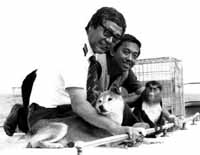
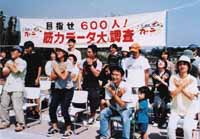
Ultra Eye,
launched in 1978 and hosted by Yamakawa Shizuo, introduced the brand
new programming concept of science for the whole family, seeking scientific
answers to questions arising from daily life.
The program's success derived from its warm
and friendly studio atmosphere and the unfailing enthusiasm of the host
as he clarified a wide range of problems using experiments on his own
body. The show's popularity was reflected in its audience share, which
averaged over 20% and reached a maximum of 29.7%.
Subsequent programs exploring the world
of science have included Try and Try, Science
Variety: Let's Compare and So That's Why! Today, scientific information
that people can use in daily life is presented on Try
and Gotcha!, which has been on the air since 1995.
Science is fun!
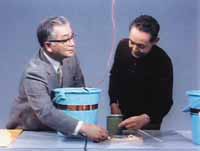
Science for Everyone
was launched on NHK Educational TV in 1963, with the goal of making
science and technology more interesting and accessible. It was aired
five days a week from Monday through Friday, with themes like Exploring
Nature and Fun in the Science Lab.
Over on NHK General, The
Four Eyes got its start in 1966. The premise of this program
was the use of special photographic techniques and apparatus to capture
phenomena normally unseen by the human eye. Techniques like high-speed
and time-lapse photography, magnification and fluoroscopy opened windows
on new worlds, and were especially successful among children. The program's
concept was later taken over by Investigative
Camera (1972-).
Science education programs are becoming
more important than ever in view of the continuing drift of young Japanese
away from scientific subjects. To help counter this trend, NHK launched
Saturday Science Club in 2002.
|
|
Robocon goes global
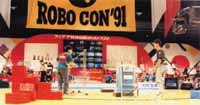
In 1988, NHK invited students from national
colleges of technology to participate in an unusual kind of competition
in the studio. The students were to build and race machines of their
own design, powered by nothing more than two dry-cell batteries. This
went on to become a regular event called Robocon—short for robot contest.
The idea became so popular that student
teams had to enter regional preliminary contests to qualify for the
national finals, held every year at Tokyo's Kokugikan Hall. Word spread
abroad, and in August 2002, students from 20 universities in the Asia-Pacific
region gathered in Japan for the ABU Robot Contest. This event, hosted
by NHK and sponsored for the first time by the Asia-Pacific Broadcasting
Union, was shown in all the participating countries, and proved to be
a big hit with viewers.
The three
rules of Ultra Eye
Ultra Eye caused a buzz with unique,
bold experiments conceived at public planning and study meetings.
In addition to host Yamakawa Shizuo and technicians and directors
from NHK, magazine editors and journalists who had dropped by to
do a story would sometimes be roped in as well.
These meetings were governed by an unwritten code of three rules:
• No laughing at a person who says something stupid
• You'll never know if you don't try
• It's not scary if everybody does it
The ideas produced in this freewheeling atmosphere were sifted and
the best ones became experiments on the show. The spirit of the
three rules of Ultra Eye continues
today on the show Try and Gotcha!. |
|